
Nebraska telemarketing & SMS rules for insurance agents
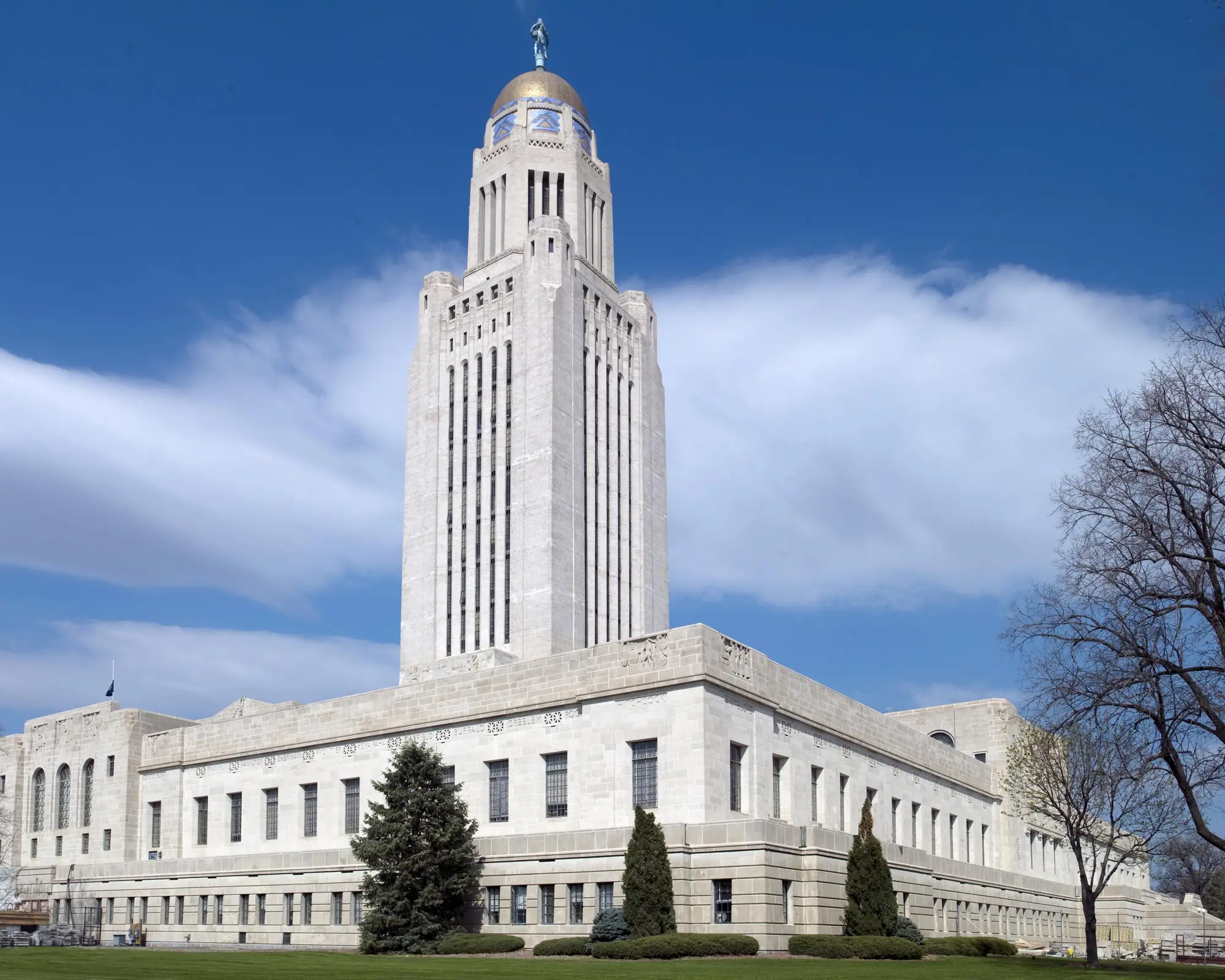
Photo: Nebraska State Capitol tower and main building — Carol M. Highsmith Archive, Library of Congress
Nebraska’s Automatic Dialing-Announcing Devices Act and the Public Service Commission’s rule limit recorded-message sales calls to a residential line to 8:00 a.m.–9:00 p.m. Monday through Saturday and 1:00–9:00 p.m. on Sundays and legal holidays, local time of the party called (291 NAC 11-003.01) — a later Sunday and holiday start than the federal 8:00 a.m.–9:00 p.m. window for residential telephone solicitations (47 CFR 64.1200(c)(1)). A call placed by a live operator without a prerecorded message is not a “telephone solicitation” under that Act (Neb. Rev. Stat. § 86-242(2)(f)), so the federal window governs live calls. Each automatic dialing-announcing device used for telephone solicitations needs a Commission permit with a $500 fee (§ 86-250(1)), such devices may not be used for solicitations to cellular numbers (§ 86-244(3)), and §§ 86-212 to 86-257 contain no exemption for insurance producers.
Nebraska regulates telephone solicitation under the Nebraska Automatic Dialing-Announcing Devices Act (Neb. Rev. Stat. §§ 86-236 to 86-257) with Public Service Commission rules (291 NAC ch. 11), and the Telemarketing and Prize Promotions Act (Neb. Rev. Stat. §§ 86-212 to 86-235) (Neb. Rev. Stat. §§ 86-212 to 86-257, 75-156; 291 Neb. Admin. Code ch. 11), which layers requirements on top of the federal TCPA. Federal law is a floor, not a ceiling: where the two differ, the stricter rule governs.
Last reviewed .
What time can I call in Nebraska?
- Live-operator calls: the federal window applies — no telephone solicitation to a residential telephone subscriber "before the hour of 8 a.m. or after 9 p.m. (local time at the called party's location)" (47 CFR 64.1200(c)(1)); the FTC rule likewise bars outbound telemarketing calls to a person’s residence outside 8:00 a.m.–9:00 p.m. at the called person’s location without that person’s prior consent (16 CFR 310.4(c)). The Automatic Dialing-Announcing Devices Act excludes from “telephone solicitation” a call "placed by a live operator and a prerecorded message is not utilized" (§ 86-242(2)(f)), and the Telemarketing and Prize Promotions Act (§§ 86-212 to 86-235) sets no calling hours. Recorded-message dialer calls: § 86-248(1)(a) bars a telephone solicitation using an automatic dialing-announcing device to a residential telephone line "before 8 a.m. or after 9 p.m. at the location of the person called." The Commission’s rule adds a later Sunday and holiday start: such calls may be made "between the hours of 8:00 AM and 9:00 PM, Monday through Saturday, and between the hours of 1:00 PM and 9:00 PM, Sunday and legal holidays. All times indicated are local times of the party called" (291 NAC 11-003.01).
Are there Sunday or holiday restrictions in Nebraska?
- For recorded-message dialer calls to a residential line: 1:00 p.m. to 9:00 p.m. on Sundays and legal holidays, and 8:00 a.m. to 9:00 p.m. Monday through Saturday, local time of the party called (291 NAC 11-003.01). Section 86-252 directs the Commission to adopt rules that include "the days of the week, holidays, and time of day when calls can be made." Live-operator calls without a prerecorded message are outside that Act (§ 86-242(2)(f)), and §§ 86-212 to 86-235 set no Sunday or holiday rule.
What consent does Nebraska require before the first call or text?
- Sections 86-212 to 86-257 contain no general prior-consent requirement for live sales calls. For recorded-message dialer calls, a call or message "made to any person with the person's prior express invitation or permission" or made to a person with whom the caller has an established business relationship is not a “telephone solicitation” (§ 86-242(2)(a)–(b)). An established business relationship is one formed by a voluntary two-way communication on the basis of an inquiry, application, purchase or transaction by the subscriber that has not been terminated by either party (§ 86-241). Other than a call for emergency purposes, a telephone solicitation using an automatic dialing-announcing device may not be made to any number assigned to a paging service, a cellular telephone service, a specialized mobile radio service, any other radio common carrier service, or any service for which the person called is charged for the call (§ 86-244(3)). Under the Telemarketing and Prize Promotions Act, a seller may not obtain or submit for payment a check, draft or other negotiable paper drawn on a consumer’s account without the consumer’s express verifiable authorization (§ 86-224).
Does Nebraska treat texting differently from calling?
- Sections 86-212 to 86-257 do not mention text messages. The Automatic Dialing-Announcing Devices Act defines “telephone solicitation” as "a telephone call or message using an automatic dialing-announcing device" (§ 86-242(1)), and an automatic dialing-announcing device is "a device which selects and dials telephone numbers and automatically plays a recorded message" (§ 86-238).
Does Nebraska have its own do-not-call list?
- Sections 86-212 to 86-257 create no state do-not-call registry. They require a caller-specific list instead: a recorded-message dialer solicitation to a residential line is barred unless the caller "has instituted procedures for maintaining a list of telephone subscribers who do not wish to receive telephone solicitations made by or on behalf of the caller" (§ 86-248(1)(b)). The minimum standards include a written policy available on demand, personnel trained in the list, recording each do-not-call request with the time it was made, and keeping the list for future solicitations (§ 86-248(2)). The Commission’s rule applies these procedures to dialer solicitations and unsolicited advertisements to a residential or business line and adds that "A caller shall at no time make telephone solicitations or unadvertised solicitations to subscribers on such list" (291 NAC 11-003.05). The Nebraska Attorney General’s consumer guidance points consumers to the Federal Trade Commission’s National Do Not Call Registry.
Do I need to register to solicit in Nebraska?
- Only for automatic dialing-announcing devices. Section 86-250(1): "A person shall not connect or operate an automatic dialing-announcing device for the purpose of making telephone solicitations on any telephone line unless the person has a current permit from the commission for the device." The applicant remits a fee of $500 for each device; a permit remains in force for two years, and each renewal application is treated as a new application (§ 86-250(1), (3)). Before connecting or operating the device, the permitholder must notify the telephone company of the line to be used (§ 86-250(4)). A person who contracts with a third party to operate a device for telephone solicitations is jointly and severally liable with that party and must file the message with the Commission, and any change to it within five days after the change (§ 86-250(5)–(6)). The Telemarketing and Prize Promotions Act (§§ 86-212 to 86-235) contains no registration requirement.
Are licensed insurance agents exempt in Nebraska?
- None. Sections 86-212 to 86-257 contain no exemption for insurance producers. The Automatic Dialing-Announcing Devices Act’s exclusions from “telephone solicitation” depend on the call, not the caller’s license: a call made with the person’s prior express invitation or permission, to a person with an established business relationship, by a tax-exempt nonprofit organization, not for commercial purposes, for a commercial purpose without an unsolicited advertisement, or placed by a live operator without a prerecorded message (§ 86-242(2)). The Telemarketing and Prize Promotions Act excludes from “seller” only certain telecommunications companies (§ 86-219), and in a civil proceeding under that Act the person claiming an exemption must prove it (§ 86-231).
What are the penalties in Nebraska?
- Automatic Dialing-Announcing Devices Act: on a written complaint and supporting affidavit, the Commission may enter an ex parte cease and desist order lasting no more than twenty days, with a hearing within twenty days, and failure to comply with an applicable law, rule or regulation is grounds for revoking or suspending a permit (§ 86-253). The Commission or a peace officer at its direction may seize without a warrant a device whose operation does not conform to § 86-244(1)–(2) or the rules, and on a finding of willful or intentional noncompliance the device may be confiscated and destroyed (§ 86-254). The Commission "may administratively fine pursuant to section 75-156 any person who violates" the Act or its rules (§ 86-257). Section 75-156(1) allows a civil penalty "of up to ten thousand dollars per day" for each violation of laws within the Commission’s jurisdiction as enumerated in § 75-109.01, on a finding that the violation is proven by clear and convincing evidence; § 75-109.01(8) lists the Automatic Dialing-Announcing Devices Act, and the penalty may not exceed two million dollars per year for each violation (§ 75-156(5)). The Commission’s rule says a violator "shall be guilty of a Class IV misdemeanor" (291 NAC 11-005.04). Telemarketing and Prize Promotions Act: a consumer who suffers a loss or harm from a violation "may recover actual damages, attorney's fees, court costs, and any other remedies provided by law" (§ 86-233); a violation is a Class I misdemeanor (§ 86-234); and a violator is subject to a civil penalty of not more than $2,000 for each violation, which the Attorney General may recover in a civil action (§ 86-235).
Controlling statute
- Nebraska Automatic Dialing-Announcing Devices Act (Neb. Rev. Stat. §§ 86-236 to 86-257) with Public Service Commission rules (291 NAC ch. 11), and the Telemarketing and Prize Promotions Act (Neb. Rev. Stat. §§ 86-212 to 86-235) — Neb. Rev. Stat. §§ 86-212 to 86-257, 75-156; 291 Neb. Admin. Code ch. 11
Other things that change the answer
- Commission rules for recorded-message solicitations also require that no message exceed two minutes (291 NAC 11-003.02); that the message clearly state the identity of the person making the call within the first twenty-five seconds and give a telephone number (not the device’s) or address, which may be a street, website or email address (291 NAC 11-003.03); and that the permit holder inspect the device at least once a month and keep inspection records for two years (291 NAC 11-003.07). By statute the device must release the called person’s line within five seconds after that person hangs up (§ 86-249), may not dial numbers sequentially (§ 86-251), and may not engage two or more lines of a business multiline system at the same time (§ 86-246). The Telemarketing and Prize Promotions Act reaches a “seller” who initiates unsolicited consumer telephone calls to sell, lease or rent consumer goods or services (§ 86-219); a call made in response to an express request, primarily in connection with an unfinished debt or contract, to a person with a clearly established business relationship, or by a magazine or newspaper publisher or its agent or employee in connection with the publisher’s business is not an “unsolicited consumer telephone call” (§ 86-222). A consumer may cancel a telephone sale until midnight of the fifth business day after receiving written notice of the right to cancel, unless the seller gives at least seven days after delivery to review goods or services and refunds returns or canceled services (§ 86-225). The Commission’s rule chapter carries a last issue date of February 27, 2018.
Sources
- Neb. Rev. Stat. § 86-242 — Telephone solicitation, definedprimary source
- Neb. Rev. Stat. § 86-244 — Telephone solicitations; restrictionsprimary source
- Neb. Rev. Stat. § 86-248 — Telephone solicitation to residential line; limitationsprimary source
- Neb. Rev. Stat. § 86-250 — Permit requiredprimary source
- Neb. Rev. Stat. § 86-257 — Violations; administrative fineprimary source
- Neb. Rev. Stat. § 75-156 — Civil penalty (Public Service Commission)primary source
- Neb. Rev. Stat. § 75-109.01 — Public Service Commission jurisdictionprimary source
- Neb. Rev. Stat. § 86-233 — Telemarketing and Prize Promotions Act, consumer remediesprimary source
- Nebraska Public Service Commission — Title 291 NAC ch. 11, Automatic Dialing-Announcing Devices Rulesprimary source
- Nebraska Attorney General — Stopping Unwanted Telemarketing, Mail, and Emailsprimary source
- 47 CFR 64.1200 — Delivery restrictions (eCFR)primary source
- 16 CFR 310.4 — Abusive telemarketing acts or practices (eCFR)primary source
How APEX enforces these rules on every send
APEX evaluates each outbound message and call before it leaves the platform. Quiet hours are applied in the contact's local time rather than the agent's, DNC scrubbing runs against federal, state, internal, and litigator lists, and every allow-or-block decision is written to an immutable audit log. See security & compliance for the full guardrail set.
Configuring a platform correctly does not by itself make a campaign lawful. You remain responsible for your consent records and your calling practices.
Rules in other states
- Alabama telemarketing rules — Ala. Code §§ 8-19A-1 to -24, 8-19C-1 to -12; Ala. Admin. Code r. 770-X-5-.17, r. 770-X-5-.31
- Alaska telemarketing rules — AS 45.50.471(b)(35), (41); AS 45.50.475; AS 45.63.010–45.63.100; 9 AAC 14.010–14.900
- Arizona telemarketing rules — A.R.S. §§ 44-1271 to 44-1282; § 44-1522; § 44-1531
- Arkansas telemarketing rules — Ark. Code Ann. §§ 4-99-103, 4-99-104, 4-99-403 to 4-99-406, 5-63-204
- California telemarketing rules — Cal. Bus. & Prof. Code §§ 17511.1, 17511.3, 17511.12, 17538.41, 17590–17594; Cal. Pub. Util. Code §§ 2871–2876; Cal. Civ. Code § 1770(a)(22)
- Colorado telemarketing rules — C.R.S. §§ 6-1-301 to 6-1-305, 6-1-901 to 6-1-908, 6-1-112, 6-1-113; 4 CCR 723-2, Rules 2890–2899
- Connecticut telemarketing rules — Conn. Gen. Stat. §§ 42-284 to 42-289
- Delaware telemarketing rules — 6 Del. C. §§ 2501A–2510A; 6 Del. C. §§ 2513, 2596; 29 Del. C. §§ 2520, 2522, 2524
- District of Columbia telemarketing rules — D.C. Code §§ 22-3226.01 to 22-3226.15
- Florida telemarketing rules — Fla. Stat. §§ 501.059, 501.604, 501.605, 501.616
- Georgia telemarketing rules — O.C.G.A. § 46-5-27 (as revised by Ga. L. 2024, Act 605 (SB 73)); Ga. Comp. R. & Regs. 515-14-1-.03, -.04, -.07; Ga. Comp. R. & Regs. 515-12-1-.32
- Hawaii telemarketing rules — HRS §§ 481P-1 to 481P-8; HRS §§ 480-2, 480-3.1, 480-13
- Idaho telemarketing rules — Idaho Code §§ 48-1001 to 48-1010; §§ 48-603A, 48-606, 48-608; IDAPA 04.02.01.160–164
- Illinois telemarketing rules — 815 ILCS 413/1 to 413/30; 815 ILCS 305/1 to 305/30; 815 ILCS 505/2Z, 505/7, 505/10a
- Indiana telemarketing rules — IC 24-4.7-1-1 to 24-4.7-5-6; IC 24-5-12; IC 24-5-14; IC 24-5-14.5; IC 24-5-0.5-3(b)(19), 24-5-0.5-4
- Iowa telemarketing rules — Iowa Code § 714.16(2)(a), (7), (15); § 714.8(15); § 68A.506; § 523C.13; § 525.1; 47 CFR 64.1200; 16 CFR 310.4
- Kansas telemarketing rules — K.S.A. 50-670, 50-670a; K.S.A. 50-671 to 50-675; K.S.A. 50-624, 50-627, 50-634, 50-636
- Kentucky telemarketing rules — KRS 367.46951–367.46999; KRS 367.461–367.469; KRS 367.990(22)–(24)
- Louisiana telemarketing rules — La. R.S. 45:810–817, 45:822, 45:844.11–844.15; LPSC General Order R-29617
- Maine telemarketing rules — 10 M.R.S. §§ 1498, 1499-A, 1499-B; 5 M.R.S. §§ 207, 209, 213
- Maryland telemarketing rules — Md. Code Ann., Com. Law §§ 14-4501–14-4503, 14-3201–14-3202; Md. Code Ann., Pub. Util. § 8-205
- Massachusetts telemarketing rules — Mass. Gen. Laws ch. 159C, §§ 1–14; 201 CMR 12.00
- Michigan telemarketing rules — MCL 445.111 to 445.111e; MCL 484.125; MCL 750.540e
- Minnesota telemarketing rules — Minn. Stat. §§ 325E.26–325E.31; §§ 325G.12–325G.14; § 8.31
- Mississippi telemarketing rules — Miss. Code §§ 77-3-601 to -619, 77-3-701 et seq.; § 83-9-110
- Missouri telemarketing rules — Mo. Rev. Stat. §§ 407.1070–407.1085, 407.1095–407.1110; 15 CSR 60-13.010–60-13.070
- Montana telemarketing rules — Mont. Code Ann. §§ 30-14-1401 to 30-14-1414; §§ 30-14-1601 to 30-14-1606; § 45-8-216
- Nevada telemarketing rules — NRS 598.0918, 598.092, 598.0999; NRS 228.500–228.640; NRS 597.812–597.818; NRS 599B.010, 599B.080; NRS 41.600
- New Hampshire telemarketing rules — RSA 359-E:1 to 359-E:11; RSA 358-A:3, 358-A:4, 358-A:10
- New Jersey telemarketing rules — N.J.S.A. 56:8-119 to 56:8-135 (P.L.2003, c.76, as amended by P.L.2003, c.208, P.L.2005, c.289, P.L.2015, c.2 and P.L.2023, c.58)
- New Mexico telemarketing rules — NMSA 1978, §§ 57-12-7, 57-12-10, 57-12-11, 57-12-22
- New York telemarketing rules — N.Y. Gen. Bus. Law §§ 399-p, 399-pp, 399-z
- North Carolina telemarketing rules — N.C. Gen. Stat. §§ 75-100 to 75-105; §§ 66-260 to 66-266
- North Dakota telemarketing rules — N.D. Cent. Code §§ 51-28-01 to 51-28-22
- Ohio telemarketing rules — Ohio Rev. Code §§ 4719.01 to 4719.22, 4719.99; Ohio Adm. Code 109:4-6-01 to 109:4-6-05
- Oklahoma telemarketing rules — 15 O.S. §§ 775A.2–775A.4, 775B.2–775B.6, 775C.2–775C.6
- Oregon telemarketing rules — ORS 646.551–646.578; ORS 646A.370–646A.376; ORS 646.608, 646.638, 646.642
- Pennsylvania telemarketing rules — Act of Dec. 4, 1996, P.L. 911, No. 147, as amended, including by Act of Oct. 4, 2019, P.L. 447, No. 73, and Act of July 20, 2026, P.L. 532, No. 47
- Rhode Island telemarketing rules — R.I. Gen. Laws §§ 5-61-1 to 5-61-6
- South Carolina telemarketing rules — S.C. Code Ann. §§ 37-21-10 to 37-21-100
- South Dakota telemarketing rules — SDCL §§ 37-30A-1 to 37-30A-17; SDCL §§ 49-31-99 to 49-31-108; ARSD 20:10:35:01 to 20:10:35:14
- Tennessee telemarketing rules — Tenn. Code Ann. §§ 65-4-401 et seq., as amended by 2023 Tenn. Pub. Acts ch. 126 and 2026 Tenn. Pub. Acts ch. 1029; Tenn. Comp. R. & Regs. 1220-04-11-.01 to -.08
- Texas telemarketing rules — Tex. Bus. & Com. Code chs. 302, 304, 305
- Utah telemarketing rules — Utah Code §§ 13-25a-102 to 13-25a-111; §§ 13-26-101 to 13-26-108
- Vermont telemarketing rules — 9 V.S.A. §§ 2464a, 2464b, 2464c, 2464d, 2464e
- Virginia telemarketing rules — Va. Code §§ 59.1-510 to 59.1-518.01
- Washington telemarketing rules — RCW 80.36.390; RCW ch. 19.158
- West Virginia telemarketing rules — W. Va. Code §§ 46A-6F-101 to 46A-6F-703
- Wisconsin telemarketing rules — Wis. Stat. §§ 100.20, 100.26, 100.52; Wis. Admin. Code ATCP 127.01, 127.02, 127.04, 127.16, 127.80–127.84
- Wyoming telemarketing rules — Wyo. Stat. §§ 40-12-301 to 40-12-305
General information, not legal advice
This page summarises state telemarketing law as it applied on the review date shown above. It is not legal advice, it does not create an attorney–client relationship, and it may not reflect amendments made since that date. State telemarketing law changes frequently and its application depends on facts specific to your business. Confirm the current statute and consult a qualified attorney before relying on any of it.
You are responsible for your own compliance and for how you use this information. APEX accepts no liability for decisions made or actions taken on the basis of this page.