
Kansas telemarketing & SMS rules for insurance agents
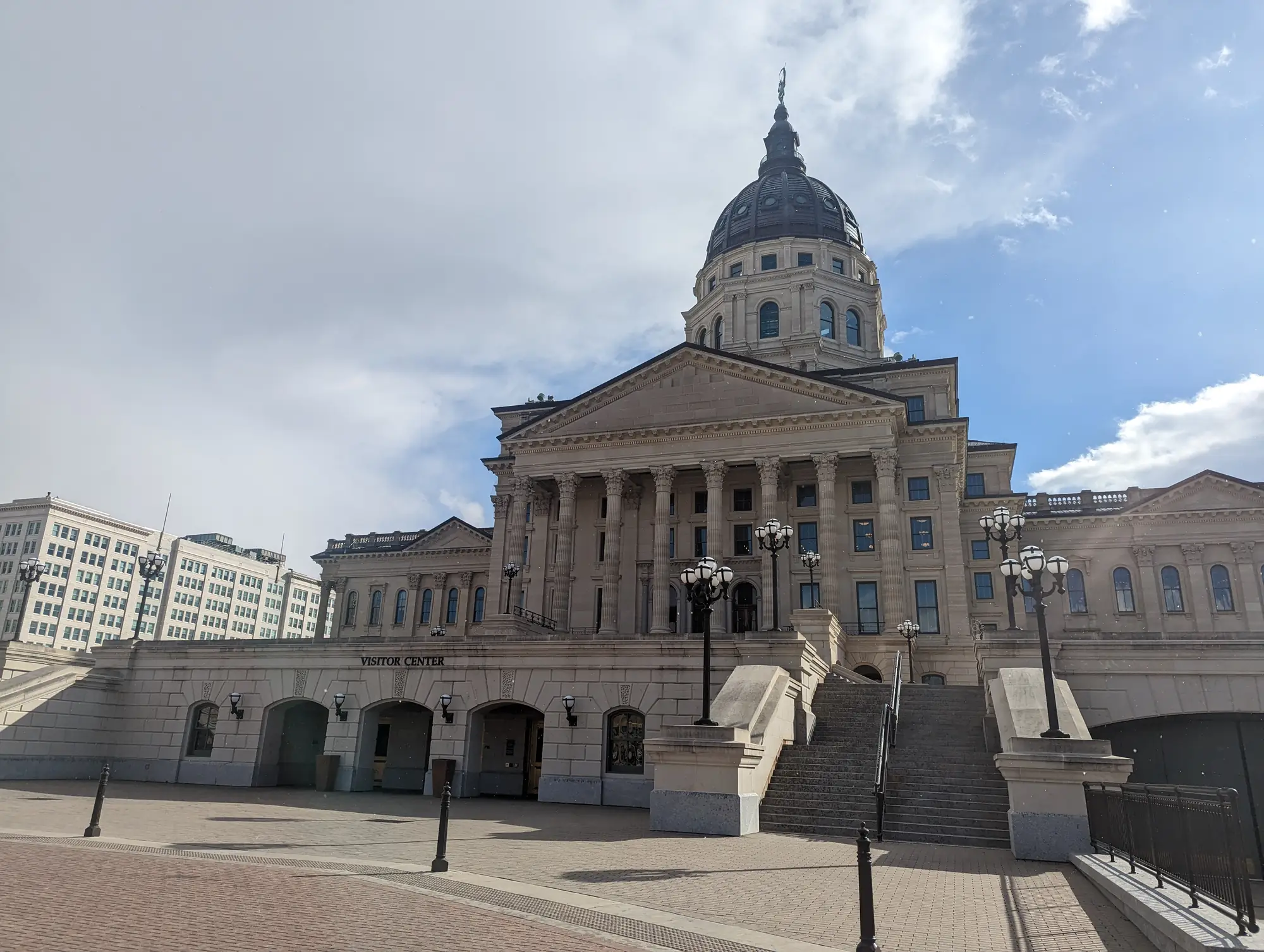
Photo: Kansas State Capitol dome and south facade — Elli, Wikimedia Commons (CC0)
Kansas sets no calling-hours rule of its own, so the federal 8:00 a.m.–9:00 p.m. window applies (47 CFR 64.1200(c)(1)). Instead, the Kansas No-Call Act designates the FTC’s national no-call list as the Kansas no-call list, requires telephone solicitors to consult it and delete listed numbers before making unsolicited consumer telephone calls and at least every 30 days after that, and makes any violation an unconscionable act under the Kansas Consumer Protection Act (K.S.A. 50-670a(a), (g), (l)), which carries a civil penalty of up to $10,000 per violation (K.S.A. 50-636(a)). The No-Call Act contains no insurance-agent exemption, but the Consumer Protection Act’s definition of “consumer transaction” excludes "insurance contracts regulated under state law" (K.S.A. 50-624(c)).
Kansas regulates telephone solicitation under the Kansas No-Call Act (K.S.A. 50-670 and 50-670a) and Kansas telemarketing confirmation law (K.S.A. 50-671 to 50-675), both part of and supplemental to the Kansas Consumer Protection Act (K.S.A. 50-670, 50-670a; K.S.A. 50-671 to 50-675; K.S.A. 50-624, 50-627, 50-634, 50-636), which layers requirements on top of the federal TCPA. Federal law is a floor, not a ceiling: where the two differ, the stricter rule governs.
Last reviewed .
What time can I call in Kansas?
- No Kansas rule; the federal 8:00 a.m. to 9:00 p.m. window at the called party’s location applies (47 CFR 64.1200(c)(1); 16 CFR 310.4(c)). K.S.A. 50-670, 50-670a and 50-671 to 50-675 contain no time-of-day rule. What Kansas regulates is how an unsolicited consumer telephone call is conducted: the telephone solicitor must identify themselves, identify the business on whose behalf they are soliciting, and identify the purpose of the call immediately on making contact; promptly discontinue the solicitation after a negative response; hang up, or disconnect an automatic dialing-announcing device, within 25 seconds after the called person ends the call; and answer the line with a live operator or device within five seconds of the beginning of the call (K.S.A. 50-670(b)).
Are there Sunday or holiday restrictions in Kansas?
- K.S.A. 50-670, 50-670a and 50-671 to 50-675 contain no Sunday or holiday rule.
What consent does Kansas require before the first call or text?
- No prior-consent requirement for calls. The No-Call Act applies to an “unsolicited consumer telephone call,” which excludes a call made "In response to an express request or with the express written agreement of the person called", a call made primarily in connection with an existing debt or contract whose payment or performance has not been completed, and a call to a person with whom the solicitor or its predecessor in interest has an established business relationship, unless the consumer has objected and asked the solicitor to stop; the solicitor "shall honor any such request for five years from the date of such request" (K.S.A. 50-670(a)(3)). An established business relationship is one formed by a voluntary two-way communication on the basis of an application, purchase or transaction by the consumer within the 18 months before the call that neither party has ended (K.S.A. 50-670(a)(7)). If an unsolicited call is answered by an automatic dialing-announcing device, the message may include only the caller and business identification required by K.S.A. 50-670(b)(1)–(2) "but shall not contain any unsolicited advertisement" (K.S.A. 50-670(b)(6)). For telemarketing sales, a consumer’s verbal agreement to buy from a telemarketer "shall not be considered valid and legally binding unless the telemarketer receives from the consumer a signed confirmation that discloses in full the terms of the sale agreed upon" (K.S.A. 50-672(a)), subject to the exemptions in K.S.A. 50-673.
Does Kansas treat texting differently from calling?
- No provision expressly addresses text messages. K.S.A. 50-670(a)(1) defines a “consumer telephone call” as "a call made by a telephone solicitor to the residence or mobile telephone number of a consumer" for the purpose of soliciting a sale or extension of credit, or obtaining information for that purpose; neither K.S.A. 50-670 nor 50-670a mentions text messages. Calls to mobile numbers are expressly covered.
Does Kansas have its own do-not-call list?
- No separate state list. K.S.A. 50-670a(l): "The national no-call list established and maintained by the federal trade commission shall be designated as the Kansas no-call list." Before making unsolicited consumer telephone calls in Kansas, and not less frequently than every 30 days after that, a telephone solicitor must consult the no-call list and delete listed numbers from its calling list, and the statute requires the Attorney General to direct consumers who want to register to contact the FTC (K.S.A. 50-670a(a)). No telephone solicitor may make or cause to be made an unsolicited consumer telephone call to a consumer whose number is on the list, and the list may be used only to remove numbers from calling lists (K.S.A. 50-670a(c)). Solicitors have up to 30 days from a number’s registration to remove it (K.S.A. 50-670a(b)). It is an affirmative defense, provable by clear and convincing evidence and usable no more than once in Kansas in any 12-month period, that the solicitor had obtained the updated list, implemented reasonable procedures with due care, trained personnel and kept compliance records, and that the call resulted from error (K.S.A. 50-670a(e)). A separate defense applies where the consumer affirmatively listed or held out a residential or mobile number as a business number, the solicitor knew of and relied on that at the time of the call, and the call was directly related to the consumer’s business (K.S.A. 50-670a(f)). Scrubbing against the national registry at least every 30 days is therefore the Kansas requirement.
Do I need to register to solicit in Kansas?
- None under the Kansas No-Call Act or the telemarketing confirmation law: K.S.A. 50-670, 50-670a and 50-671 to 50-675 contain no registration or bonding requirement for telephone solicitors or telemarketers. They regulate the sale instead: a telemarketer may not charge a consumer’s credit card until it has received an original signed confirmation that complies with K.S.A. 50-672, and merchandise sent or services provided without that confirmation are treated as unsolicited goods (K.S.A. 50-672(c)). A consumer is not liable to pay for goods or services from a telemarketer unless the telemarketer first received the consumer’s signed confirmation (K.S.A. 50-672(d)). The confirmation rules do not apply to the transactions listed in K.S.A. 50-673, including a sale by a business that has made a prior sale to the consumer or has a clear, preexisting business relationship with the consumer, provided that relationship made the consumer aware of the business’s full name, address and phone number and the business is not a telecommunications provider (K.S.A. 50-673(b)).
Are licensed insurance agents exempt in Kansas?
- No exemption appears in the No-Call Act, but a Consumer Protection Act exclusion may matter. K.S.A. 50-670 and 50-670a contain no exemption for insurance agents or insurers; the only carve-outs are the exclusions from “unsolicited consumer telephone call” for calls made at the consumer’s express request or with their express written agreement, calls about an existing debt or contract, and calls to a person with whom the solicitor has an established business relationship (K.S.A. 50-670(a)(3)), plus the affirmative defenses in K.S.A. 50-670a(e)–(f). A “telephone solicitor” includes any person who makes or causes to be made a consumer telephone call (K.S.A. 50-670(a)(4)). However, the No-Call Act works by making violations unconscionable acts under the Kansas Consumer Protection Act, and that Act defines “consumer transaction” as a sale or other disposition of property or services in Kansas "except insurance contracts regulated under state law" (K.S.A. 50-624(c)); its unconscionability section applies to a supplier "in connection with a consumer transaction" (K.S.A. 50-627(a)). The statutes do not say whether that exclusion limits No-Call Act enforcement against calls soliciting insurance. Federal law, including the national Do Not Call rules and the 8:00 a.m.–9:00 p.m. window, applies to insurance calls on its own terms.
What are the penalties in Kansas?
- Any violation of K.S.A. 50-670 or 50-670a "is an unconscionable act or practice under the Kansas consumer protection act" (K.S.A. 50-670(g); 50-670a(g)), and both sections are part of and supplemental to that Act (K.S.A. 50-670(h); 50-670a(n)). Under the Consumer Protection Act, a violation renders the violator liable for a civil penalty, recoverable in an individual action including one brought by the Attorney General or a county or district attorney, "of not more than $10,000 for each violation" (K.S.A. 50-636(a)). A supplier that willfully violates a court order issued under the Act forfeits a civil penalty of not more than $20,000 per violation (K.S.A. 50-636(b)). A consumer aggrieved by a violation may recover, but not in a class action, "damages or a civil penalty as provided in subsection (a) of K.S.A. 50-636 ... whichever is greater" (K.S.A. 50-634(b)), and may seek a declaratory judgment or injunction (K.S.A. 50-634(a)); the court may award reasonable attorney fees to a prevailing consumer when the supplier has committed a violation and the action has ended in a judgment or settlement (K.S.A. 50-634(e)). A telemarketer’s attempt to collect a fee, enforce a credit card charge or refuse a refund in violation of K.S.A. 50-671 to 50-675 is an unconscionable act within the meaning of K.S.A. 50-627 (K.S.A. 50-675(b)). Penalties and fees recovered from prosecutions of violations of K.S.A. 50-670a are paid to the Attorney General to investigate and prosecute violations of that section (K.S.A. 50-670a(i)).
Controlling statute
- Kansas No-Call Act (K.S.A. 50-670 and 50-670a) and Kansas telemarketing confirmation law (K.S.A. 50-671 to 50-675), both part of and supplemental to the Kansas Consumer Protection Act — K.S.A. 50-670, 50-670a; K.S.A. 50-671 to 50-675; K.S.A. 50-624, 50-627, 50-634, 50-636
Other things that change the answer
- K.S.A. 50-670 was last amended by L. 2014, ch. 18, § 1, and K.S.A. 50-670a by L. 2014, ch. 18, § 2. A telephone solicitor may not withhold the display of its telephone number from a caller identification service when the number is used for telemarketing (K.S.A. 50-670(c)), and may not send written information by fax or computer to a consumer who has asked, orally or in writing, that such transmissions stop (K.S.A. 50-670(d)). A solicitor may not use a professional delivery, courier or other pickup service to obtain a consumer’s payment unless the goods are delivered with the opportunity to inspect before payment is collected (K.S.A. 50-670(e)). The Attorney General may adopt rules and regulations to carry out the No-Call Act, including rules adopting provisions of the FTC’s Telemarketing Sales Rule, 16 C.F.R. part 310, and a violation of those rules is a violation of K.S.A. 50-670a (K.S.A. 50-670a(m)). For K.S.A. 50-671 to 50-674, a telemarketing sale is considered to take place in the state where the consumer is located, regardless of where the telemarketer is (K.S.A. 50-674).
Sources
- K.S.A. 50-670 — Definitions; requirements and prohibitions; remediesprimary source
- K.S.A. 50-670a — No-call list; prohibitions; remedies; attorney generalprimary source
- K.S.A. 50-672 — Verbal agreement not valid unless signed confirmationprimary source
- K.S.A. 50-673 — When law inapplicableprimary source
- K.S.A. 50-674 — Where law enforcedprimary source
- K.S.A. 50-675 — Supplemental to Kansas consumer protection actprimary source
- K.S.A. 50-624 — Kansas Consumer Protection Act definitionsprimary source
- K.S.A. 50-627 — Unconscionable acts and practicesprimary source
- K.S.A. 50-634 — Private remediesprimary source
- K.S.A. 50-636 — Civil penaltiesprimary source
- 47 CFR 64.1200 — Delivery restrictions (eCFR)primary source
- 16 CFR 310.4 — Abusive telemarketing acts or practices (eCFR)primary source
How APEX enforces these rules on every send
APEX evaluates each outbound message and call before it leaves the platform. Quiet hours are applied in the contact's local time rather than the agent's, DNC scrubbing runs against federal, state, internal, and litigator lists, and every allow-or-block decision is written to an immutable audit log. See security & compliance for the full guardrail set.
Configuring a platform correctly does not by itself make a campaign lawful. You remain responsible for your consent records and your calling practices.
Rules in other states
- Alabama telemarketing rules — Ala. Code §§ 8-19A-1 to -24, 8-19C-1 to -12; Ala. Admin. Code r. 770-X-5-.17, r. 770-X-5-.31
- Alaska telemarketing rules — AS 45.50.471(b)(35), (41); AS 45.50.475; AS 45.63.010–45.63.100; 9 AAC 14.010–14.900
- Arizona telemarketing rules — A.R.S. §§ 44-1271 to 44-1282; § 44-1522; § 44-1531
- Arkansas telemarketing rules — Ark. Code Ann. §§ 4-99-103, 4-99-104, 4-99-403 to 4-99-406, 5-63-204
- California telemarketing rules — Cal. Bus. & Prof. Code §§ 17511.1, 17511.3, 17511.12, 17538.41, 17590–17594; Cal. Pub. Util. Code §§ 2871–2876; Cal. Civ. Code § 1770(a)(22)
- Colorado telemarketing rules — C.R.S. §§ 6-1-301 to 6-1-305, 6-1-901 to 6-1-908, 6-1-112, 6-1-113; 4 CCR 723-2, Rules 2890–2899
- Connecticut telemarketing rules — Conn. Gen. Stat. §§ 42-284 to 42-289
- Delaware telemarketing rules — 6 Del. C. §§ 2501A–2510A; 6 Del. C. §§ 2513, 2596; 29 Del. C. §§ 2520, 2522, 2524
- District of Columbia telemarketing rules — D.C. Code §§ 22-3226.01 to 22-3226.15
- Florida telemarketing rules — Fla. Stat. §§ 501.059, 501.604, 501.605, 501.616
- Georgia telemarketing rules — O.C.G.A. § 46-5-27 (as revised by Ga. L. 2024, Act 605 (SB 73)); Ga. Comp. R. & Regs. 515-14-1-.03, -.04, -.07; Ga. Comp. R. & Regs. 515-12-1-.32
- Hawaii telemarketing rules — HRS §§ 481P-1 to 481P-8; HRS §§ 480-2, 480-3.1, 480-13
- Idaho telemarketing rules — Idaho Code §§ 48-1001 to 48-1010; §§ 48-603A, 48-606, 48-608; IDAPA 04.02.01.160–164
- Illinois telemarketing rules — 815 ILCS 413/1 to 413/30; 815 ILCS 305/1 to 305/30; 815 ILCS 505/2Z, 505/7, 505/10a
- Indiana telemarketing rules — IC 24-4.7-1-1 to 24-4.7-5-6; IC 24-5-12; IC 24-5-14; IC 24-5-14.5; IC 24-5-0.5-3(b)(19), 24-5-0.5-4
- Iowa telemarketing rules — Iowa Code § 714.16(2)(a), (7), (15); § 714.8(15); § 68A.506; § 523C.13; § 525.1; 47 CFR 64.1200; 16 CFR 310.4
- Kentucky telemarketing rules — KRS 367.46951–367.46999; KRS 367.461–367.469; KRS 367.990(22)–(24)
- Louisiana telemarketing rules — La. R.S. 45:810–817, 45:822, 45:844.11–844.15; LPSC General Order R-29617
- Maine telemarketing rules — 10 M.R.S. §§ 1498, 1499-A, 1499-B; 5 M.R.S. §§ 207, 209, 213
- Maryland telemarketing rules — Md. Code Ann., Com. Law §§ 14-4501–14-4503, 14-3201–14-3202; Md. Code Ann., Pub. Util. § 8-205
- Massachusetts telemarketing rules — Mass. Gen. Laws ch. 159C, §§ 1–14; 201 CMR 12.00
- Michigan telemarketing rules — MCL 445.111 to 445.111e; MCL 484.125; MCL 750.540e
- Minnesota telemarketing rules — Minn. Stat. §§ 325E.26–325E.31; §§ 325G.12–325G.14; § 8.31
- Mississippi telemarketing rules — Miss. Code §§ 77-3-601 to -619, 77-3-701 et seq.; § 83-9-110
- Missouri telemarketing rules — Mo. Rev. Stat. §§ 407.1070–407.1085, 407.1095–407.1110; 15 CSR 60-13.010–60-13.070
- Montana telemarketing rules — Mont. Code Ann. §§ 30-14-1401 to 30-14-1414; §§ 30-14-1601 to 30-14-1606; § 45-8-216
- Nebraska telemarketing rules — Neb. Rev. Stat. §§ 86-212 to 86-257, 75-156; 291 Neb. Admin. Code ch. 11
- Nevada telemarketing rules — NRS 598.0918, 598.092, 598.0999; NRS 228.500–228.640; NRS 597.812–597.818; NRS 599B.010, 599B.080; NRS 41.600
- New Hampshire telemarketing rules — RSA 359-E:1 to 359-E:11; RSA 358-A:3, 358-A:4, 358-A:10
- New Jersey telemarketing rules — N.J.S.A. 56:8-119 to 56:8-135 (P.L.2003, c.76, as amended by P.L.2003, c.208, P.L.2005, c.289, P.L.2015, c.2 and P.L.2023, c.58)
- New Mexico telemarketing rules — NMSA 1978, §§ 57-12-7, 57-12-10, 57-12-11, 57-12-22
- New York telemarketing rules — N.Y. Gen. Bus. Law §§ 399-p, 399-pp, 399-z
- North Carolina telemarketing rules — N.C. Gen. Stat. §§ 75-100 to 75-105; §§ 66-260 to 66-266
- North Dakota telemarketing rules — N.D. Cent. Code §§ 51-28-01 to 51-28-22
- Ohio telemarketing rules — Ohio Rev. Code §§ 4719.01 to 4719.22, 4719.99; Ohio Adm. Code 109:4-6-01 to 109:4-6-05
- Oklahoma telemarketing rules — 15 O.S. §§ 775A.2–775A.4, 775B.2–775B.6, 775C.2–775C.6
- Oregon telemarketing rules — ORS 646.551–646.578; ORS 646A.370–646A.376; ORS 646.608, 646.638, 646.642
- Pennsylvania telemarketing rules — Act of Dec. 4, 1996, P.L. 911, No. 147, as amended, including by Act of Oct. 4, 2019, P.L. 447, No. 73, and Act of July 20, 2026, P.L. 532, No. 47
- Rhode Island telemarketing rules — R.I. Gen. Laws §§ 5-61-1 to 5-61-6
- South Carolina telemarketing rules — S.C. Code Ann. §§ 37-21-10 to 37-21-100
- South Dakota telemarketing rules — SDCL §§ 37-30A-1 to 37-30A-17; SDCL §§ 49-31-99 to 49-31-108; ARSD 20:10:35:01 to 20:10:35:14
- Tennessee telemarketing rules — Tenn. Code Ann. §§ 65-4-401 et seq., as amended by 2023 Tenn. Pub. Acts ch. 126 and 2026 Tenn. Pub. Acts ch. 1029; Tenn. Comp. R. & Regs. 1220-04-11-.01 to -.08
- Texas telemarketing rules — Tex. Bus. & Com. Code chs. 302, 304, 305
- Utah telemarketing rules — Utah Code §§ 13-25a-102 to 13-25a-111; §§ 13-26-101 to 13-26-108
- Vermont telemarketing rules — 9 V.S.A. §§ 2464a, 2464b, 2464c, 2464d, 2464e
- Virginia telemarketing rules — Va. Code §§ 59.1-510 to 59.1-518.01
- Washington telemarketing rules — RCW 80.36.390; RCW ch. 19.158
- West Virginia telemarketing rules — W. Va. Code §§ 46A-6F-101 to 46A-6F-703
- Wisconsin telemarketing rules — Wis. Stat. §§ 100.20, 100.26, 100.52; Wis. Admin. Code ATCP 127.01, 127.02, 127.04, 127.16, 127.80–127.84
- Wyoming telemarketing rules — Wyo. Stat. §§ 40-12-301 to 40-12-305
General information, not legal advice
This page summarises state telemarketing law as it applied on the review date shown above. It is not legal advice, it does not create an attorney–client relationship, and it may not reflect amendments made since that date. State telemarketing law changes frequently and its application depends on facts specific to your business. Confirm the current statute and consult a qualified attorney before relying on any of it.
You are responsible for your own compliance and for how you use this information. APEX accepts no liability for decisions made or actions taken on the basis of this page.