
Alabama telemarketing & SMS rules for insurance agents
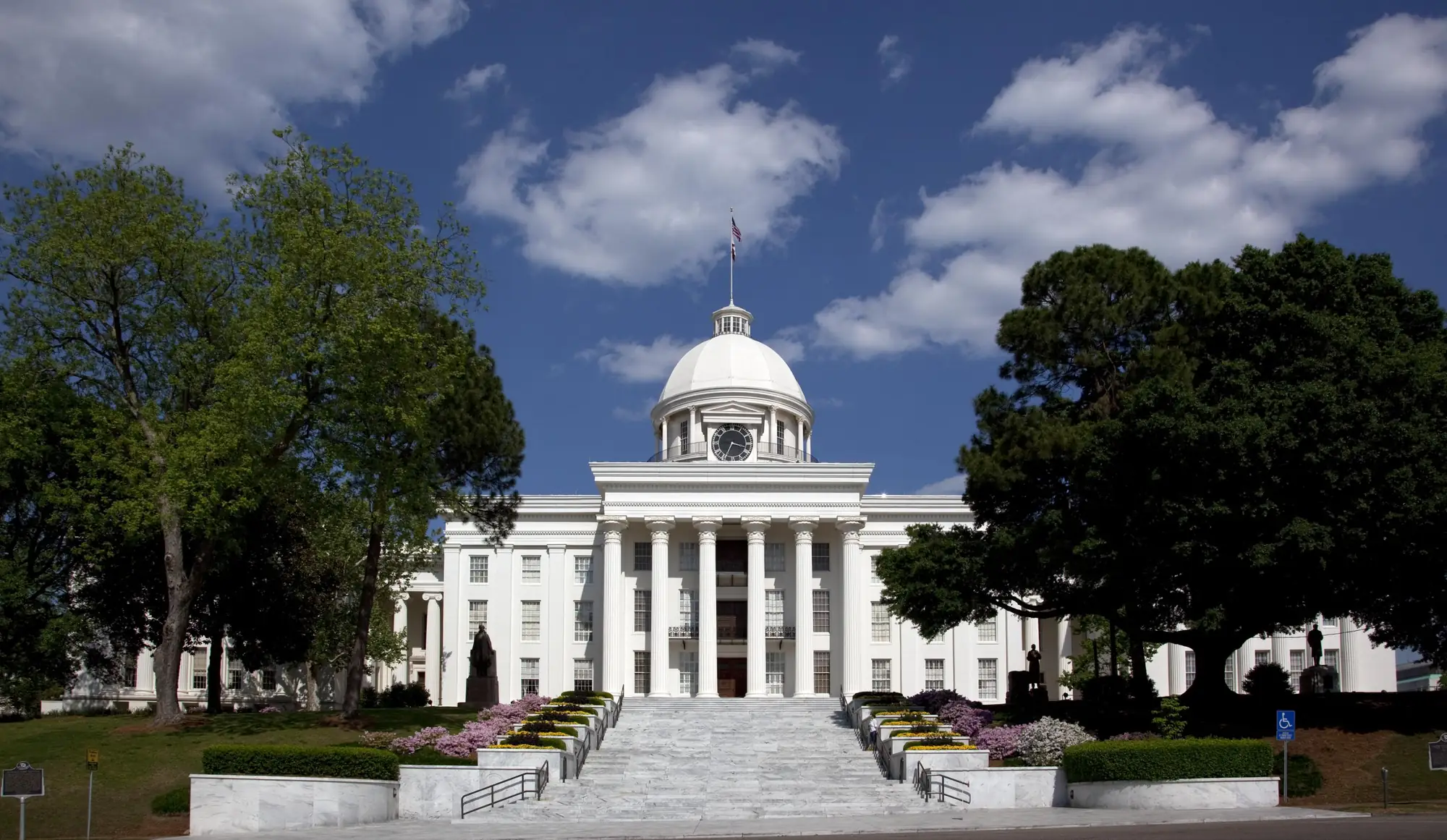
Photo: Alabama State Capitol, Montgomery — Carol M. Highsmith Archive, Library of Congress
An Alabama Public Service Commission rule says no live or automated solicitation calls to consumers in Alabama may be placed before 8:00 a.m. or after 8:00 p.m., or at any time on Sundays or holidays (Ala. Admin. Code r. 770-X-5-.17(1)(b), (2)(b)). The 8:00 p.m. cutoff is an hour earlier than the federal 9:00 p.m. limit (47 C.F.R. § 64.1200(c)(1)), and the PSC rule states no insurance exemption. Licensed insurance brokers, agents, customer representatives and solicitors are exempt from the Alabama Telemarketing Act, including its seller license and bond, when soliciting within the scope of their license (Ala. Code § 8-19A-4(9)). The Act’s definition of "telephone solicitation" excludes communications by or on behalf of exempt persons, and that definition also governs chapter 8-19C unless the context clearly indicates otherwise. Those calls therefore also fall outside the state do-not-call prohibition (§§ 8-19A-3(17), 8-19C-2(a)). Confirm with counsel before treating a licensed producer as outside the PSC calling-hours rule.
Alabama regulates telephone solicitation under the Alabama Telemarketing Act (Ala. Code ch. 8-19A), Ala. Code ch. 8-19C (do-not-call database) and Alabama Public Service Commission Rules 770-X-5-.17 and 770-X-5-.31 (Ala. Code §§ 8-19A-1 to -24, 8-19C-1 to -12; Ala. Admin. Code r. 770-X-5-.17, r. 770-X-5-.31), which layers requirements on top of the federal TCPA. Federal law is a floor, not a ceiling: where the two differ, the stricter rule governs.
Last reviewed .
What time can I call in Alabama?
- 8:00 a.m. to 8:00 p.m., with no solicitation calls on Sundays or holidays. Ala. Admin. Code r. 770-X-5-.17(2) applies "to all live solicitation telephone calls to consumers in the State of Alabama". Subsection (2)(b) says: "No solicitation calls are allowed on Sundays or holidays. On the days that calls are allowed, none will be placed prior to 8 a.m. or after 8 p.m." Subsection (1)(b) uses the same words for automated solicitation calls. The rule does not say whose time zone applies. The federal rule allows 8:00 a.m. to 9:00 p.m. local time at the called party’s location (47 C.F.R. § 64.1200(c)(1)). No time-of-day rule was found in Ala. Code chapters 8-19A or 8-19C.
Are there Sunday or holiday restrictions in Alabama?
- No solicitation calls, live or automated, on Sundays or holidays (Ala. Admin. Code r. 770-X-5-.17(1)(b), (2)(b)). The rule text does not define “holidays.”
What consent does Alabama require before the first call or text?
- No prior-express-consent requirement for solicitation calls was found in Ala. Code chapters 8-19A or 8-19C, or in PSC Rules 770-X-5-.17 and 770-X-5-.31. The only permission requirement in the PSC rule concerns recording: "If the consumer's response is to be recorded, they must be informed of such and permission must be granted" (r. 770-X-5-.17(1)(c), (2)(c)).
Does Alabama treat texting differently from calling?
- No Alabama text-message rule was found in Ala. Code chapters 8-19A or 8-19C or in PSC Rules 770-X-5-.17 and 770-X-5-.31. Section 8-19A-3(17), which also governs chapter 8-19C unless the context clearly indicates otherwise, defines "telephone solicitation" as "A voice communication over a telephone line" for sales purposes. Rule 770-X-5-.31(1)(o) uses the same words. Neither mentions text messages. Separately, the Act’s definition of "commercial telephone solicitation," which triggers the seller license, includes some "other communication" that invites a response by telephone or is followed by a sales call. "Other communication" means "a written or oral notification or advertisement transmitted through any means" (§ 8-19A-3(3)). The Act does not say whether that reaches text messages.
Does Alabama have its own do-not-call list?
- The statute created a PSC do-not-call database, and the PSC now says it has merged its register with the national list. Ala. Code § 8-19C-2(a) bars telephone solicitations to the telephone line of any residential subscriber "who has given notice to the commission of his or her objection to receiving telephone solicitations." Under § 8-19C-2(b)(4), if the Federal Communications Commission establishes a single national database under 47 U.S.C. § 227(c)(3), the PSC "shall include the part of the single national database that relates to Alabama" in its database. The PSC’s website says "Alabama has adopted the National Do Not Call Registry and has merged its register with the national list administered by the FTC." It adds that people enrolled on Alabama’s register before August 14, 2003 do not have to register again to be included on the national register. Rule 770-X-5-.31(4)(b)1 still provides for solicitor access to the database on payment of "a non-refundable annual fee of $500"; check with the PSC whether it still distributes a state list or charges that fee. Business telephone subscribers may not be included on the register (r. 770-X-5-.31(6)(d), the subsection on consumer registration).
Do I need to register to solicit in Alabama?
- Yes for commercial telephone sellers. Licensed insurance agents soliciting within the scope of their license are excluded. Ala. Code § 8-19A-5(a): "Prior to doing business in this state, a commercial telephone seller shall obtain a license from the division," meaning the Consumer Division of the Attorney General’s office (§ 8-19A-3(7)). Doing business in Alabama includes solicitation from other states or nations of purchasers located in Alabama. The application must be accompanied by a bond, letter of credit or certificate of deposit of at least $50,000 (§§ 8-19A-5(f)(1), 8-19A-10(b)) and a $500 annual license fee (§ 8-19A-5(f)(2)). Salespersons must hold their own license, with a $50 annual fee (§§ 8-19A-7(b)(2), 8-19A-15(d)). Persons exempted by § 8-19A-4, including licensed insurance agents soliciting within the scope of their license, are not commercial telephone sellers (§§ 8-19A-3(2), 8-19A-4(9)). Individuals exempted by § 8-19A-4, and employees or agents of exempt persons, are not salespersons (§ 8-19A-3(15)). Separately, PSC Rule 770-X-5-.17(1)(l) says all persons who use automatic dialing and announcing devices to make solicitation calls "shall register with the Secretary's Office of the Alabama Public Service Commission." That rule states no insurance exemption.
Are licensed insurance agents exempt in Alabama?
- Yes from the Telemarketing Act and the do-not-call statute; none is stated in the PSC calling-hours rule. Ala. Code § 8-19A-4(9) says the chapter does not apply to "Any licensed insurance broker, agent, customer representative, or solicitor when soliciting within the scope of his or her license." The section defines that phrase to mean one licensed "by an official or agency of this state or of any state of the United States licensed in accordance with the Alabama Insurance Code (Title 27)." That removes the seller license, bond and salesperson license. Section 8-19A-3(17) defines "telephone solicitation" to exclude "communications by or on behalf of any of the exempt persons in Section 8-19A-4." Section 8-19A-3 also applies to chapter 8-19C unless the context clearly indicates otherwise, so the do-not-call prohibition in § 8-19C-2(a) does not reach those calls. PSC Rule 770-X-5-.31(1)(o) contains the same exclusion. In a civil proceeding alleging a violation of chapter 8-19A, the person claiming an exemption bears the burden of proving it (§ 8-19A-22). Insurers subject to supervision by an official or agency of Alabama, any state or the United States are separately exempt as supervised financial institutions (§ 8-19A-4(8)). PSC Rule 770-X-5-.17 sets the 8 a.m.–8 p.m. and Sunday and holiday limits. It applies to "all live solicitation telephone calls to consumers in the State of Alabama" and, in subsection (1), to all automated solicitation calls, and it states no insurance exemption. Confirm with counsel before treating a licensed producer as outside the calling-hours rule.
What are the penalties in Alabama?
- Under the Alabama Telemarketing Act, a person who violates the chapter "is liable for a civil penalty of up to ten thousand dollars ($10,000) for each violation" (§ 8-19A-18(a)). The division or the court may waive it if the person has already made full restitution or paid actual damages (§ 8-19A-18(d)). For a commercial telephone seller or salesperson, soliciting without a license is a Class C felony (§ 8-19A-21(c)). A person injured by a violation of the chapter may sue for actual damages and any damages available at common law or by statute, including actual costs, court costs and attorney’s fees (§ 8-19A-23). For a knowing or threatened knowing violation of the do-not-call prohibition (§ 8-19C-2(a)) or the identification and caller-ID requirements (§ 8-19C-5), the PSC may start proceedings in circuit court. Those proceedings include an order imposing a civil penalty "up to a maximum of two thousand dollars ($2,000) for each violation" (§ 8-19C-6). A person who receives more than one solicitation violating those sections within 12 months, by or on behalf of the same person or entity, may sue to enjoin the violation, to recover actual monetary loss or up to $2,000 in damages for each knowing violation (whichever is greater), or both (§ 8-19C-7). It is a defense that the defendant established and implemented, with due care, reasonable practices and procedures to effectively prevent violating solicitations (§ 8-19C-8). Actions under §§ 8-19C-6 and -7 may not be brought more than two years after the claimant knew or should have known of the violation, or more than two years after any state proceeding or action ends, whichever is later (§ 8-19C-9). PSC Rule 770-X-5-.17 states that a violation of its requirements "will result in immediate action to discontinue service."
Controlling statute
- Alabama Telemarketing Act (Ala. Code ch. 8-19A), Ala. Code ch. 8-19C (do-not-call database) and Alabama Public Service Commission Rules 770-X-5-.17 and 770-X-5-.31 — Ala. Code §§ 8-19A-1 to -24, 8-19C-1 to -12; Ala. Admin. Code r. 770-X-5-.17, r. 770-X-5-.31
Other things that change the answer
- Rule 770-X-5-.17 lists its statutory authority as Code of Ala. 1975, §§ 37-1-57, 37-2-3 and 37-2-10. Those sections cover reports from utilities, the PSC’s supervision of transportation companies, and tariffs filed by transportation companies. The rule’s stated enforcement runs through telephone service: local exchange companies file tariff revisions for "disconnection of service for violation of these rules" (r. 770-X-5-.17(1)(m), (2)(i)). Its history note says it took effect in June 1968, was amended in April 1988 and March 1993, and was filed with LRS and for codification on February 5, 2013. For live calls, the same rule also bars sequential dialing. It requires the name and telephone number of the individual or firm making or paying for the call within 10 seconds after the called party answers (r. 770-X-5-.17(2)(a), (d)); for automated calls the window is twenty seconds (r. 770-X-5-.17(1)(e)). For commercial telephone sellers and salespersons, § 8-19A-12(a) separately requires stating the caller’s true name, the company on whose behalf the solicitation is made, and the consumer goods or services being sold within the first 30 seconds of the call.
Sources
- Ala. Admin. Code r. 770-X-5-.17 — Live and Automated Solicitations and Announcementsprimary source
- Ala. Admin. Code r. 770-X-5-.31 — Telephone Solicitation Regulations, Do Not Call Registerprimary source
- Ala. Code § 8-19A-3 — Definitionsprimary source
- Ala. Code § 8-19A-4 — Exemptionsprimary source
- Ala. Code § 8-19A-5 — Licensing; application for licenseprimary source
- Ala. Code § 8-19A-7 — Salesperson license application; feeprimary source
- Ala. Code § 8-19A-10 — Financial requirementsprimary source
- Ala. Code § 8-19A-12 — Oral disclosuresprimary source
- Ala. Code § 8-19A-18 — Civil penaltiesprimary source
- Ala. Code § 8-19A-21 — Criminal penaltiesprimary source
- Ala. Code § 8-19A-22 — Burden of proofprimary source
- Ala. Code § 8-19A-23 — Injured person’s right of recoveryprimary source
- Ala. Code § 8-19C-2 — Database of subscribers objecting to telephone solicitationsprimary source
- Ala. Code § 8-19C-6 — Violationsprimary source
- Ala. Code § 8-19C-7 — Action to enjoin violationsprimary source
- Ala. Code § 8-19C-9 — Limitationsprimary source
- Alabama Public Service Commission — Register for Do Not Callprimary source
- 47 C.F.R. § 64.1200 — Delivery restrictions (federal calling hours)primary source
How APEX enforces these rules on every send
APEX evaluates each outbound message and call before it leaves the platform. Quiet hours are applied in the contact's local time rather than the agent's, DNC scrubbing runs against federal, state, internal, and litigator lists, and every allow-or-block decision is written to an immutable audit log. See security & compliance for the full guardrail set.
Configuring a platform correctly does not by itself make a campaign lawful. You remain responsible for your consent records and your calling practices.
Rules in other states
- Alaska telemarketing rules — AS 45.50.471(b)(35), (41); AS 45.50.475; AS 45.63.010–45.63.100; 9 AAC 14.010–14.900
- Arizona telemarketing rules — A.R.S. §§ 44-1271 to 44-1282; § 44-1522; § 44-1531
- Arkansas telemarketing rules — Ark. Code Ann. §§ 4-99-103, 4-99-104, 4-99-403 to 4-99-406, 5-63-204
- California telemarketing rules — Cal. Bus. & Prof. Code §§ 17511.1, 17511.3, 17511.12, 17538.41, 17590–17594; Cal. Pub. Util. Code §§ 2871–2876; Cal. Civ. Code § 1770(a)(22)
- Colorado telemarketing rules — C.R.S. §§ 6-1-301 to 6-1-305, 6-1-901 to 6-1-908, 6-1-112, 6-1-113; 4 CCR 723-2, Rules 2890–2899
- Connecticut telemarketing rules — Conn. Gen. Stat. §§ 42-284 to 42-289
- Delaware telemarketing rules — 6 Del. C. §§ 2501A–2510A; 6 Del. C. §§ 2513, 2596; 29 Del. C. §§ 2520, 2522, 2524
- District of Columbia telemarketing rules — D.C. Code §§ 22-3226.01 to 22-3226.15
- Florida telemarketing rules — Fla. Stat. §§ 501.059, 501.604, 501.605, 501.616
- Georgia telemarketing rules — O.C.G.A. § 46-5-27 (as revised by Ga. L. 2024, Act 605 (SB 73)); Ga. Comp. R. & Regs. 515-14-1-.03, -.04, -.07; Ga. Comp. R. & Regs. 515-12-1-.32
- Hawaii telemarketing rules — HRS §§ 481P-1 to 481P-8; HRS §§ 480-2, 480-3.1, 480-13
- Idaho telemarketing rules — Idaho Code §§ 48-1001 to 48-1010; §§ 48-603A, 48-606, 48-608; IDAPA 04.02.01.160–164
- Illinois telemarketing rules — 815 ILCS 413/1 to 413/30; 815 ILCS 305/1 to 305/30; 815 ILCS 505/2Z, 505/7, 505/10a
- Indiana telemarketing rules — IC 24-4.7-1-1 to 24-4.7-5-6; IC 24-5-12; IC 24-5-14; IC 24-5-14.5; IC 24-5-0.5-3(b)(19), 24-5-0.5-4
- Iowa telemarketing rules — Iowa Code § 714.16(2)(a), (7), (15); § 714.8(15); § 68A.506; § 523C.13; § 525.1; 47 CFR 64.1200; 16 CFR 310.4
- Kansas telemarketing rules — K.S.A. 50-670, 50-670a; K.S.A. 50-671 to 50-675; K.S.A. 50-624, 50-627, 50-634, 50-636
- Kentucky telemarketing rules — KRS 367.46951–367.46999; KRS 367.461–367.469; KRS 367.990(22)–(24)
- Louisiana telemarketing rules — La. R.S. 45:810–817, 45:822, 45:844.11–844.15; LPSC General Order R-29617
- Maine telemarketing rules — 10 M.R.S. §§ 1498, 1499-A, 1499-B; 5 M.R.S. §§ 207, 209, 213
- Maryland telemarketing rules — Md. Code Ann., Com. Law §§ 14-4501–14-4503, 14-3201–14-3202; Md. Code Ann., Pub. Util. § 8-205
- Massachusetts telemarketing rules — Mass. Gen. Laws ch. 159C, §§ 1–14; 201 CMR 12.00
- Michigan telemarketing rules — MCL 445.111 to 445.111e; MCL 484.125; MCL 750.540e
- Minnesota telemarketing rules — Minn. Stat. §§ 325E.26–325E.31; §§ 325G.12–325G.14; § 8.31
- Mississippi telemarketing rules — Miss. Code §§ 77-3-601 to -619, 77-3-701 et seq.; § 83-9-110
- Missouri telemarketing rules — Mo. Rev. Stat. §§ 407.1070–407.1085, 407.1095–407.1110; 15 CSR 60-13.010–60-13.070
- Montana telemarketing rules — Mont. Code Ann. §§ 30-14-1401 to 30-14-1414; §§ 30-14-1601 to 30-14-1606; § 45-8-216
- Nebraska telemarketing rules — Neb. Rev. Stat. §§ 86-212 to 86-257, 75-156; 291 Neb. Admin. Code ch. 11
- Nevada telemarketing rules — NRS 598.0918, 598.092, 598.0999; NRS 228.500–228.640; NRS 597.812–597.818; NRS 599B.010, 599B.080; NRS 41.600
- New Hampshire telemarketing rules — RSA 359-E:1 to 359-E:11; RSA 358-A:3, 358-A:4, 358-A:10
- New Jersey telemarketing rules — N.J.S.A. 56:8-119 to 56:8-135 (P.L.2003, c.76, as amended by P.L.2003, c.208, P.L.2005, c.289, P.L.2015, c.2 and P.L.2023, c.58)
- New Mexico telemarketing rules — NMSA 1978, §§ 57-12-7, 57-12-10, 57-12-11, 57-12-22
- New York telemarketing rules — N.Y. Gen. Bus. Law §§ 399-p, 399-pp, 399-z
- North Carolina telemarketing rules — N.C. Gen. Stat. §§ 75-100 to 75-105; §§ 66-260 to 66-266
- North Dakota telemarketing rules — N.D. Cent. Code §§ 51-28-01 to 51-28-22
- Ohio telemarketing rules — Ohio Rev. Code §§ 4719.01 to 4719.22, 4719.99; Ohio Adm. Code 109:4-6-01 to 109:4-6-05
- Oklahoma telemarketing rules — 15 O.S. §§ 775A.2–775A.4, 775B.2–775B.6, 775C.2–775C.6
- Oregon telemarketing rules — ORS 646.551–646.578; ORS 646A.370–646A.376; ORS 646.608, 646.638, 646.642
- Pennsylvania telemarketing rules — Act of Dec. 4, 1996, P.L. 911, No. 147, as amended, including by Act of Oct. 4, 2019, P.L. 447, No. 73, and Act of July 20, 2026, P.L. 532, No. 47
- Rhode Island telemarketing rules — R.I. Gen. Laws §§ 5-61-1 to 5-61-6
- South Carolina telemarketing rules — S.C. Code Ann. §§ 37-21-10 to 37-21-100
- South Dakota telemarketing rules — SDCL §§ 37-30A-1 to 37-30A-17; SDCL §§ 49-31-99 to 49-31-108; ARSD 20:10:35:01 to 20:10:35:14
- Tennessee telemarketing rules — Tenn. Code Ann. §§ 65-4-401 et seq., as amended by 2023 Tenn. Pub. Acts ch. 126 and 2026 Tenn. Pub. Acts ch. 1029; Tenn. Comp. R. & Regs. 1220-04-11-.01 to -.08
- Texas telemarketing rules — Tex. Bus. & Com. Code chs. 302, 304, 305
- Utah telemarketing rules — Utah Code §§ 13-25a-102 to 13-25a-111; §§ 13-26-101 to 13-26-108
- Vermont telemarketing rules — 9 V.S.A. §§ 2464a, 2464b, 2464c, 2464d, 2464e
- Virginia telemarketing rules — Va. Code §§ 59.1-510 to 59.1-518.01
- Washington telemarketing rules — RCW 80.36.390; RCW ch. 19.158
- West Virginia telemarketing rules — W. Va. Code §§ 46A-6F-101 to 46A-6F-703
- Wisconsin telemarketing rules — Wis. Stat. §§ 100.20, 100.26, 100.52; Wis. Admin. Code ATCP 127.01, 127.02, 127.04, 127.16, 127.80–127.84
- Wyoming telemarketing rules — Wyo. Stat. §§ 40-12-301 to 40-12-305
General information, not legal advice
This page summarises state telemarketing law as it applied on the review date shown above. It is not legal advice, it does not create an attorney–client relationship, and it may not reflect amendments made since that date. State telemarketing law changes frequently and its application depends on facts specific to your business. Confirm the current statute and consult a qualified attorney before relying on any of it.
You are responsible for your own compliance and for how you use this information. APEX accepts no liability for decisions made or actions taken on the basis of this page.